
Why Does Adding Filters Reduce My Dating Pool?
Every required condition narrows the group to people who satisfy all active conditions at once. Here is how that intersection works—and why a smaller estimate is not a verdict on your standards.
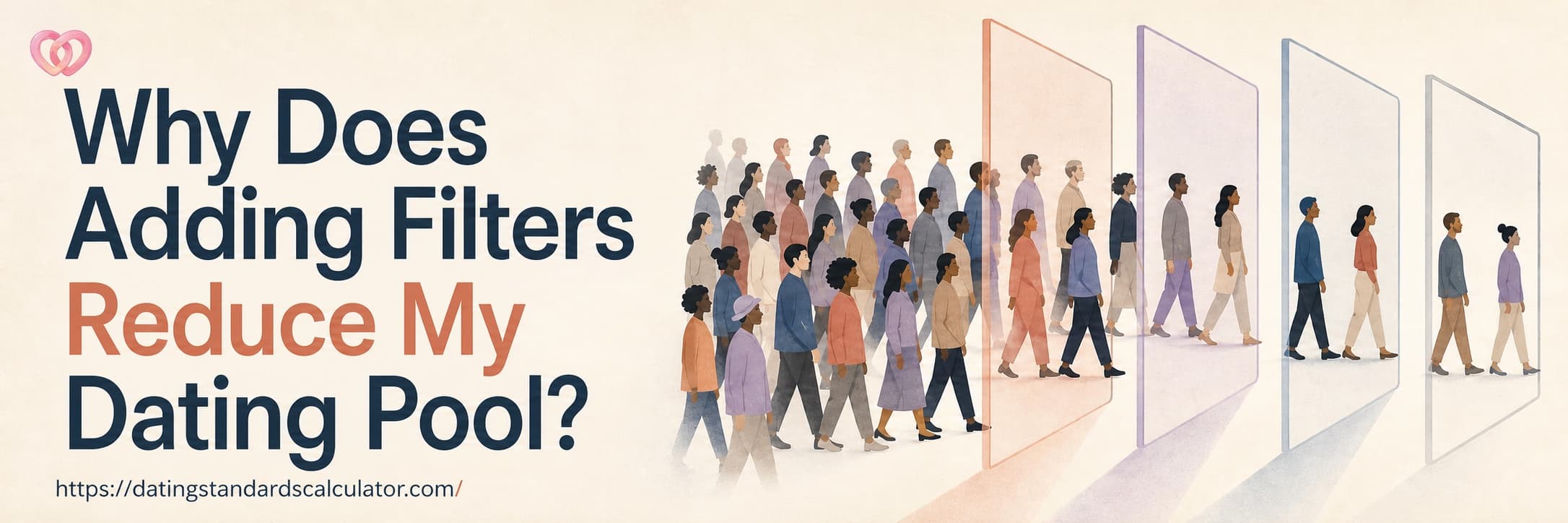
Why does adding filters reduce my dating pool? Because each required filter keeps only the people who meet that condition and every condition already active. You are measuring an intersection, not adding separate pools together. A new requirement can leave the estimate unchanged or make it smaller, but it cannot add people who failed an existing requirement.
The key distinction
A filter answers “who remains after this condition?” It does not answer whether those people are available, mutually interested, emotionally compatible, or likely to form a relationship with you.
A dating standards calculator can make these trade-offs visible by changing one measurable condition at a time. Treat the result as a planning scenario, not a prediction of who you will meet or love.
Adding filters creates a smaller intersection
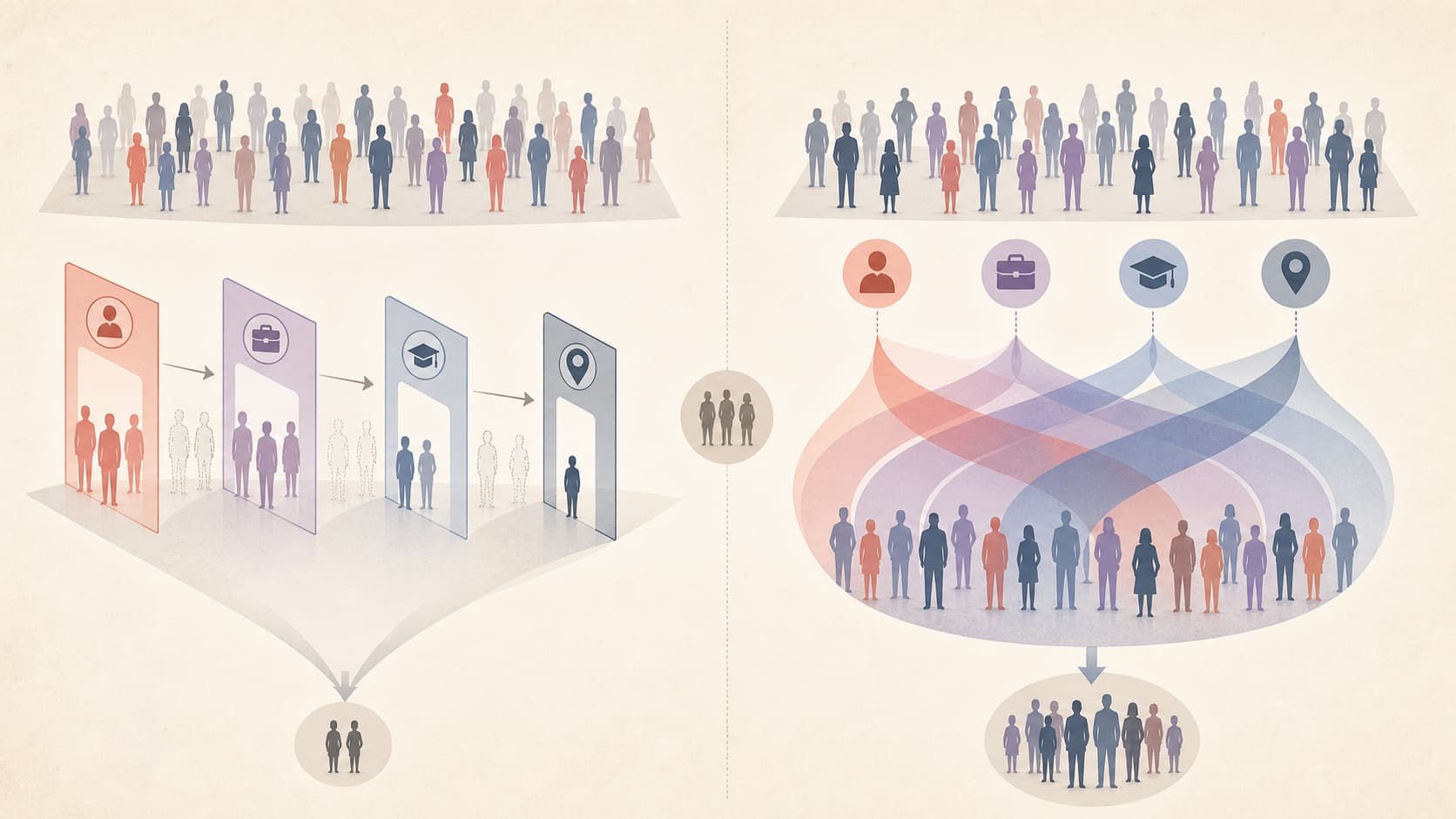
Imagine beginning with all relevant adults in a chosen geography. An age requirement keeps one subset. A relationship-status requirement then keeps only people inside that subset who also meet the second condition. A height or income preference repeats the process.
The order in which you display the filters does not change the final logical intersection, but it does change the apparent marginal impact at each step. A condition that looks powerful when applied first may remove fewer people after another condition has already narrowed the group.

A simple illustration of compounding filters
Suppose an imaginary starting pool contains 10,000 people. If an age condition keeps 40%, the scenario has 4,000 people left. If a second condition keeps half of that remaining group, 2,000 remain. If a third keeps one quarter of the people still eligible, the result becomes 500.
| Stage | Illustrative retention | People remaining |
|---|---|---|
| Starting population | 100% | 10,000 |
| After age condition | 40% of the prior group | 4,000 |
| After second condition | 50% of the prior group | 2,000 |
| After third condition | 25% of the prior group | 500 |
This is an editorial illustration, not a claim about the prevalence of any real trait. Actual estimates require a defined geography, population base, source year, variables, survey weights, and uncertainty.
Why simple multiplication can shrink the pool too much
Multiplying broad percentages assumes the conditions are independent unless the calculation uses a joint dataset. Real demographic traits often are not independent. Age, education, income, location, and marital status can be related. Applying a nationwide rate to an already narrow local age group may therefore overstate or understate the reduction.
A stronger method filters weighted person-level records so the relationships already present in the data remain visible. When joint records are unavailable, the estimate should use conservative adjustments, show a range, and label the assumption instead of presenting false precision.
For a fuller explanation of model assumptions, read how to evaluate dating-pool estimate accuracy and limitations.
A demographic pool is not your real relationship pool
Public datasets can describe measurable characteristics. They generally cannot tell whether a person is actively dating, reachable through your channels, interested in your gender, interested in you specifically, compatible in daily life, or ready for the same relationship.
Those layers matter in both directions. Meeting your preferences does not mean someone will choose you, and mutual attraction does not guarantee safety, shared values, timing, or long-term fit. A demographic result is best read as a rough eligible-share scenario before those unknowns.

This is also why the approximate count matters alongside the rate. The guide to interpreting a dating-pool percentage explains why the same percentage can mean very different things in a large city and a small local market.
How to review filters without lowering core standards
- Separate standards from proxies. Respect, consent, honesty, and compatible relationship goals protect relationship quality. A job title, exact height, or narrow label may only approximate another need.
- Change one variable at a time. This reveals the marginal effect of a single condition instead of hiding it inside several simultaneous changes.
- Check the population base. Confirm the geography, age range, relationship-status definition, source year, and whether the estimate uses weighted records.
- Ask what the filter predicts. Keep a condition when it directly supports safety or the life you need. Reconsider it when it excludes people without measuring the underlying quality.
If you decide that one condition is flexible, the guide to expanding your pool without dropping core standards offers a one-variable testing approach.
See each condition's effect
Build a scenario, switch one measurable preference at a time, and keep the limits of the estimate in view.
Explore Your PreferencesDating-filter FAQs
Why does adding filters reduce my dating pool?
Each required filter keeps only people who meet that condition and every condition already selected. The result is an intersection, so it can stay the same or become smaller but cannot become larger. The size of the change depends on the filter, the starting population, and how strongly the traits overlap.
Do dating filters multiply together?
They can be multiplied only as a rough illustration when the rates use the same population base and the traits are treated as independent. Real traits such as age, education, income, location, and relationship status can be related, so a responsible estimate should model their joint distribution or clearly dampen and label the assumption.
Which filters usually shrink a dating pool the most?
The largest effect comes from whichever active requirement excludes the greatest share of your current pool. A narrow age band, small geographic radius, strict relationship-status rule, or uncommon threshold can have a large effect, but the order and local population both matter.
Does a small dating pool mean my standards are unrealistic?
No. A small modeled pool means a measurable combination is uncommon in the selected population. It does not judge whether a boundary is healthy or whether a relationship goal is worthwhile. Review weak proxies and flexible preferences before changing standards tied to safety, respect, or essential compatibility.
Can removing one filter increase my dating pool?
Yes, if that filter was actively excluding people. The increase may be small when the condition overlaps heavily with other active filters, or larger when it removes a distinct part of the population. Change one condition at a time to see its marginal effect.
Sources and editorial methodology
This article was written by Adam.W and reviewed on July 29, 2026. It answers an information-seeking question about set intersections and demographic estimation. We reviewed official survey documentation, variable definitions, and measured-data sources. The numerical example is clearly labeled as an illustration and is not a prevalence claim.
The article distinguishes demographic prevalence from active dating availability, access, mutual interest, compatibility, and relationship outcomes. It is educational and does not offer individualized relationship, statistical, medical, or mental-health advice.
Bottom line
Adding filters reduces a dating pool because every required condition keeps only the shared overlap. The reduction may look dramatic when several conditions compound, and it can be misleading when correlated traits are treated as independent. Use the estimate to compare scenarios, not to judge your worth or predict a relationship. Protect core standards, test weak proxies one at a time, and keep the model's missing layers visible.