
How to Expand Your Dating Pool: 9 Practical Ways
Expand access before lowering standards: create more ways to meet people, test flexible filters one at a time, and protect the boundaries that make a relationship safe and workable.

How to expand your dating pool: the short answer
To expand your dating pool, increase the number and variety of suitable people you can actually meet. Add recurring social settings, ask trusted friends for introductions, use online and offline channels together, widen travel distance only when it is practical, and reconsider one nonessential filter at a time.
The goal is not “accept anyone.”
Keep standards for safety, respect, character, relationship intent, and major life compatibility. Broaden access and challenge weak proxies—not your boundaries.
If you want a baseline before changing anything, a dating standards calculator can show which measurable filters have the largest estimated effect. Treat the result as a scenario, not a prediction of who is single, interested, available, or compatible.
If the number falls faster than expected, learn why multiple filters create a smaller intersection before deciding which condition to test.
What “expanding your pool” actually means
Your practical pool is smaller than the population around you. Someone must be within reach, relationship-available, mutually interested, and compatible enough to explore a connection. Public demographic data can describe the first layer better than the others; it cannot identify your future partner.
In practice, you can widen three levers: access (where and how you meet), eligibility (which flexible filters you apply), and conversion (whether a suitable introduction becomes a real conversation or date). This article focuses on those controllable levers, not a supposedly ideal percentage.
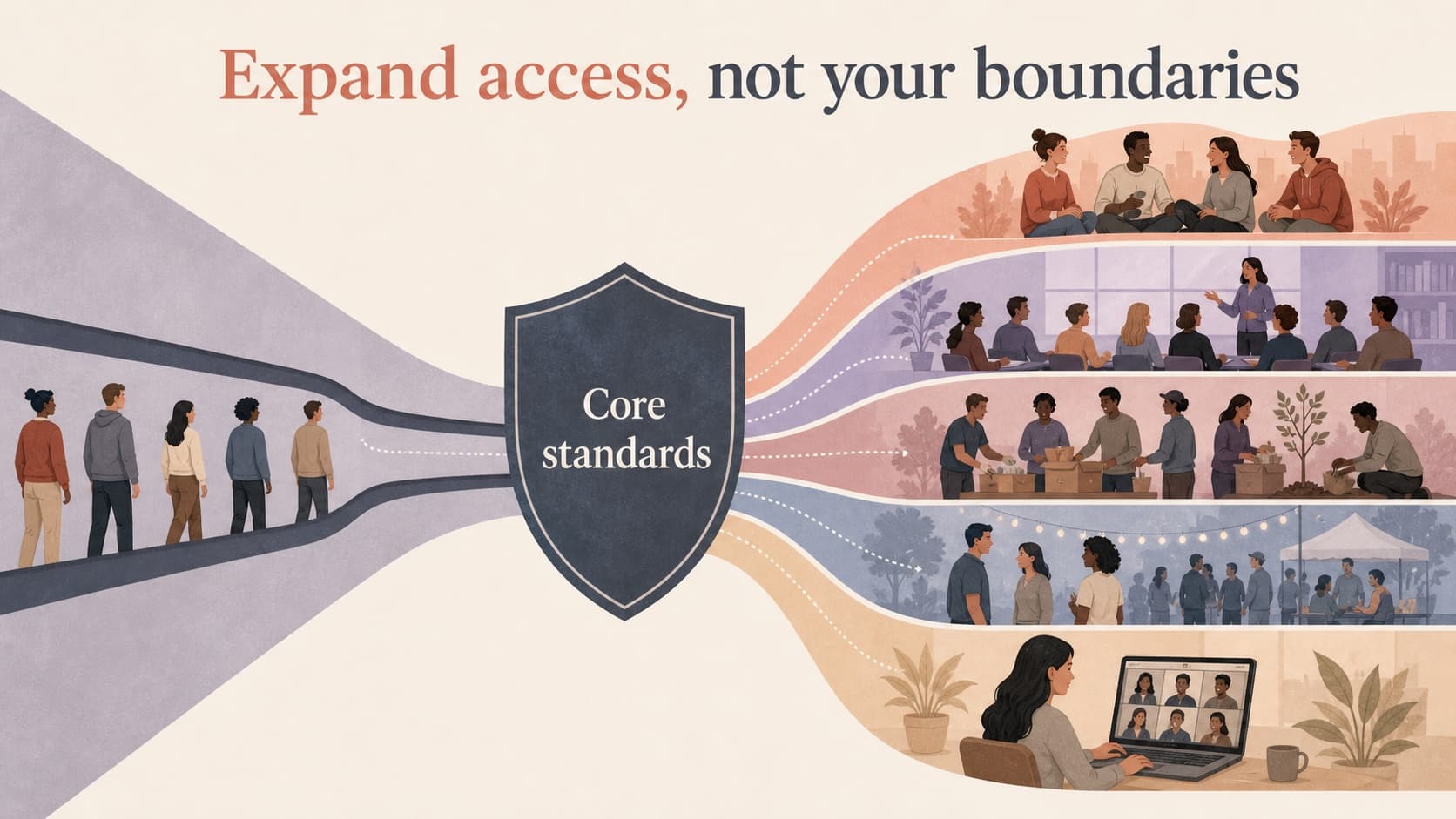
Nine practical ways to widen your opportunities
Start with the options that increase exposure without changing who you are willing to build a relationship with.
1. Use more than one meeting channel
Do not make one app, one workplace, or one friendship group carry your entire dating life. Combine online dating with introductions, recurring activities, community events, volunteering, or professional and alumni networks that fit your genuine interests.
2. Choose recurring groups, not only one-off events
A weekly class, sports group, community project, or club creates repeated low-pressure contact. Familiarity gives people time to notice character and conversational fit that a single high-stakes encounter may hide.
3. Ask for specific introductions
Tell a few trusted people that you are open to meeting someone. Describe two or three relationship-relevant qualities rather than an exhaustive physical checklist, and make it easy for friends to decline the role of matchmaker.
4. Expand your radius realistically
A larger map is useful only when you can turn a match into regular time together. Test nearby neighborhoods, commuting corridors, or adjacent cities while accounting for travel time, cost, schedules, and who would make the trip.
5. Broaden a narrow age band carefully
If your age filter is based on habit rather than a life-stage need, move one boundary slightly and observe the quality of conversations. Keep constraints that genuinely affect plans for children, caregiving, retirement, or lifestyle.
6. Translate proxy filters into the real need
An exact salary may be standing in for stability; a degree for curiosity; a height threshold for attraction; a job title for ambition. Search for the underlying quality directly when the proxy excludes people who could meet the real need.
7. Improve discoverability and follow-through
Opportunity depends partly on whether people can understand and approach you. Use clear, current photos and specific profile language, reply intentionally, suggest a safe meeting when interest is mutual, and close conversations respectfully when it is not.
8. Build a fuller social life for its own sake
Choose activities you would value even if no date appears. That protects other participants from feeling treated as prospects and gives you a sustainable routine, broader friendships, and more natural introductions.
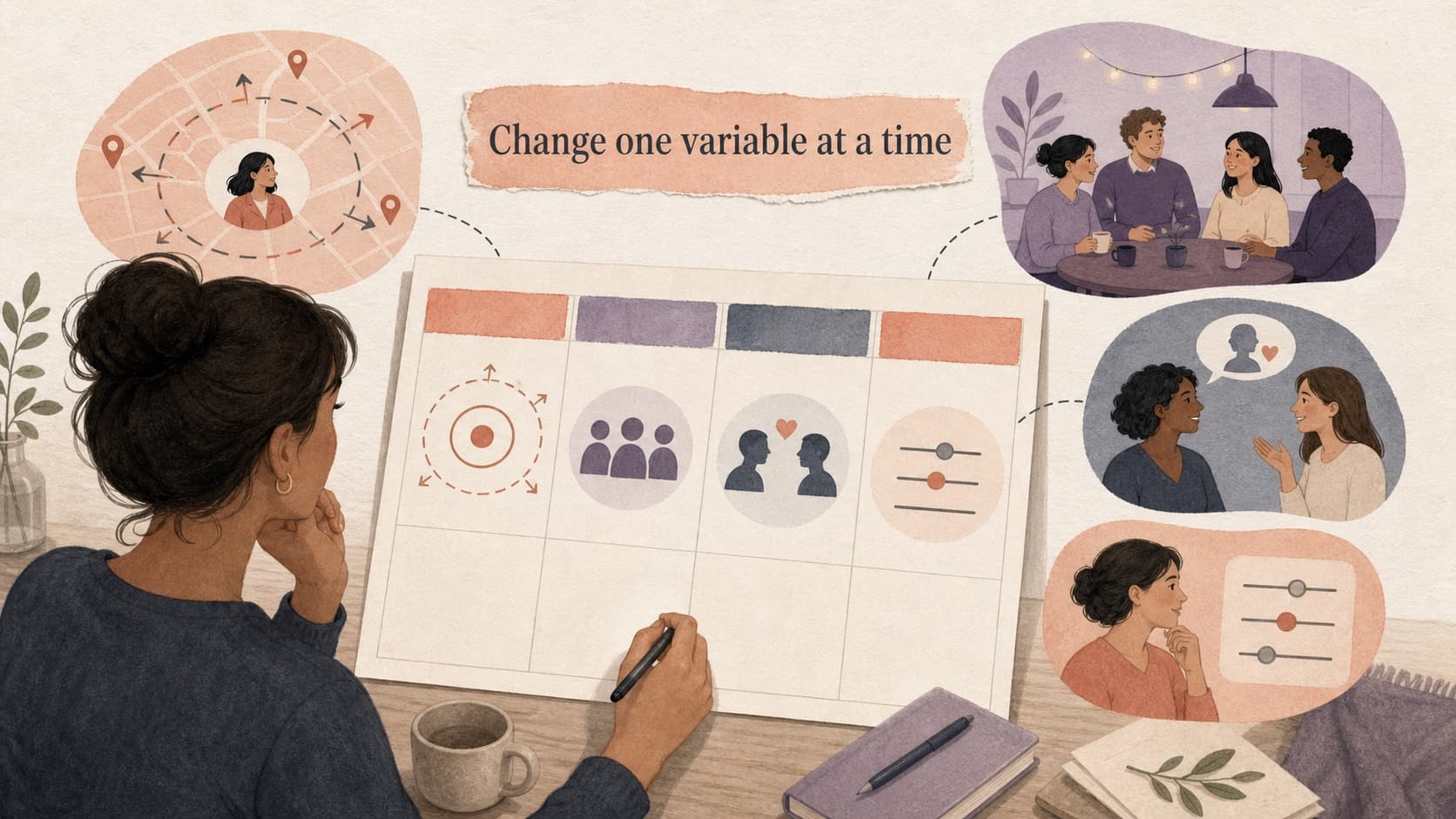
9. Run one-variable experiments
Change one channel, radius, or flexible filter at a time. Otherwise, you cannot tell what improved access. Compare meaningful conversations, compatible introductions, and second dates—not just the number of profiles shown.

What to keep firm—and what to test
| Usually keep firm | Potentially test |
|---|---|
| Consent, safety, and respect | An exact height cutoff |
| Compatible relationship intentions | A single job title or degree label |
| Major life plans and values | A very narrow age band |
| Emotional availability and honesty | One neighborhood or social “type” |
This distinction is contextual, not a universal rule. For example, distance may be flexible for a remote worker but nonnegotiable for a parent with local caregiving duties. Use the broader framework in separating healthy standards from preferences and keep any criterion that protects your real life.
If you are unsure whether the issue is pool size or the meaning of the estimate, read how to interpret a dating-pool percentage. The percentage itself is not a grade.
Try a four-week, one-variable experiment
Four weeks is an editorial planning window, not a scientifically validated deadline. Pick one change—one new recurring group, a modest radius increase, friend introductions, or one relaxed proxy filter—and apply it consistently.
- Write down the change and the reason for testing it.
- Keep your safety and relationship dealbreakers unchanged.
- Track suitable introductions, meaningful conversations, and second dates.
- Note travel, time, stress, and whether the people felt more compatible.
- Keep, revise, or reverse the change based on quality—not raw volume.
Test preferences without turning the result into a verdict
Adjust one measurable preference, compare the estimate, and decide whether the real-life tradeoff makes sense for you.
Explore Your PreferencesMeasure opportunity quality, not just quantity
Matches and profile views are weak outcome measures. A better review asks whether you met more plausible partners, had more reciprocal conversations, felt safe and respected, and reached more second dates you genuinely wanted.
Initial attraction is also dyadic: research in a real-life speed-dating setting found that attraction reflected the person, the partner, and their unique pairing. That is one reason a demographic shortlist cannot substitute for meeting. If you use an estimate, also understand what demographic models can and cannot measure.
Dating-pool expansion FAQs
How can I expand my dating pool?
Expand access before lowering standards: use more than one way to meet people, join recurring social settings, tell trusted friends you are open to introductions, widen distance only as far as you can realistically travel, and test one flexible preference at a time.
How to expand your dating pool without lowering standards?
Keep standards tied to safety, respect, character, relationship goals, and practical compatibility. Review proxy filters such as an exact height, job title, narrow age band, or one education label when they do not directly measure the quality you need.
Should I increase my dating-app radius?
Only when the added travel is sustainable. Consider how often you could meet, who would travel, transport cost, work schedules, and whether a relationship could become more geographically practical over time.
Does dating more people improve the chance of finding a partner?
More suitable introductions can create more opportunities, but volume alone does not guarantee mutual interest or a healthy relationship. Track the quality of conversations and second dates, not only matches or first dates.
How long should I test a change to my dating pool?
There is no universal duration. A four-week experiment is a practical editorial suggestion: change one variable, make a consistent effort, record what happened, and keep the change only if it improves access without harming safety or compatibility.
Sources and editorial methodology
Adam.W reviewed this guide on July 26, 2026. It combines practical editorial guidance with U.S. government information about geography and mobility, survey research on online dating, and peer-reviewed attraction research. No source establishes a universal ideal pool size or guarantees that a tactic will produce a relationship. The guide is educational and should be adapted to personal safety, accessibility, finances, culture, caregiving, and local conditions.
Bottom line
The best way to expand your dating pool is to create more realistic opportunities while keeping the standards that protect your well-being and future. Diversify how you meet people, test one weak proxy at a time, and judge each change by the quality of real interactions—not by how many profiles appear.