
What Is a Good Dating Pool Percentage?
There is no universal target. The useful question is whether the percentage represents enough relevant people for the way you actually date.
The short answer
A good dating pool percentage is not one fixed number. It is a result that leaves a workable number of relevant people for your location, timeline, and opportunities to meet, without asking you to discard standards tied to safety and core compatibility.
A percentage becomes useful only after you know its denominator. Five percent of 100,000 relevant adults is very different from five percent of 400. The result also says nothing about how many matches are single, actively dating, close enough to meet, mutually interested, or compatible with your relationship goals.
No government dataset or peer-reviewed relationship standard defines 1%, 5%, 10%, or 20% as the correct target. Any range should therefore be treated as a planning aid, not a pass-or-fail judgment.
You can use the dating standards calculator to compare how individual preferences change your estimated search breadth, then return to this guide to interpret the percentage in context.
What a dating pool percentage actually measures
A dating pool percentage estimates the share of a reference population that appears to satisfy selected measurable filters. Those filters may include age, location, relationship status, height, income, education, or other available demographic variables.
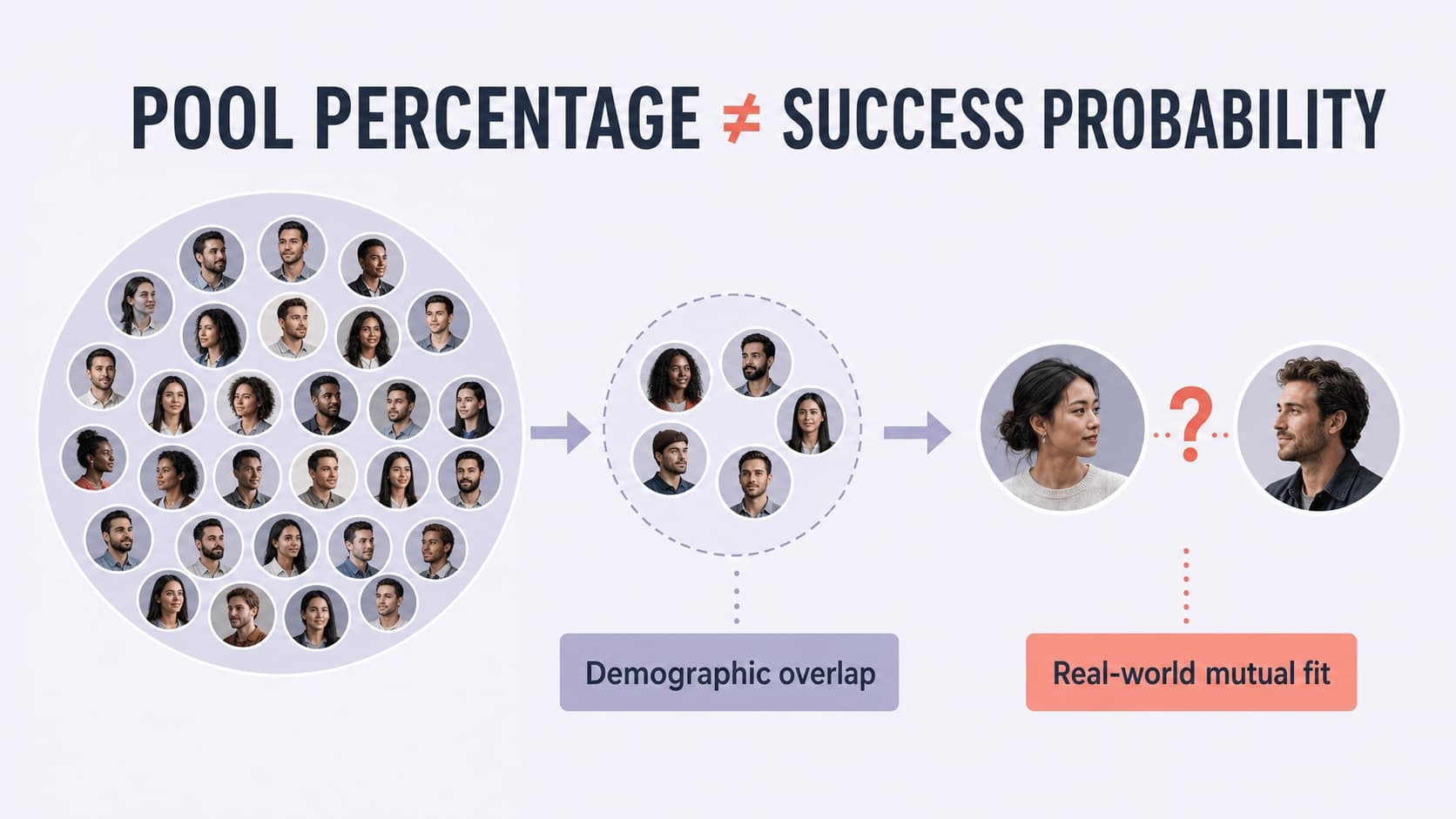
It is best understood as estimated demographic overlap. It is not your probability of meeting a partner, getting a date, or building a lasting relationship. Those outcomes require several additional events that a population model cannot observe.
For a deeper explanation of data quality, denominators, and correlated filters, read how dating pool estimates handle accuracy and limitations.
A practical way to interpret common percentage ranges
The following bands are an editorial interpretation framework. They are not validated scientific thresholds and should never be used without an approximate local count.
Above 20%
Broad within the model. Real-world availability and compatibility may do more narrowing than demographic filters.
5%-20%
Focused but often workable when the relevant local population and your opportunities to meet people are sufficiently large.
1%-5%
Narrow. Geography, age range, active-dating share, and meeting volume become increasingly important.
Below 1%
Very narrow in the reference population. Translate the result into a count and sensitivity-test flexible filters before drawing a conclusion.
These ranges describe selectivity inside a model. They do not tell you whether a result is morally good, emotionally healthy, or guaranteed to work. A lower percentage may be reasonable for someone with a large local network and no urgency. A higher percentage may still feel impractical if few people in the reference group are available or reachable.
Convert the percentage into an approximate number of people
A percentage alone hides scale. Use this simple planning calculation:
relevant population × estimated percentage = demographic matches
| Relevant population | Result | Approximate demographic matches |
|---|---|---|
| 50,000 | 1% | 500 |
| 5,000 | 5% | 250 |
| 400 | 10% | 40 |
These examples stop at demographic overlap. The practical pool will be smaller after accounting for relationship availability, active dating, distance, mutual interest, and compatibility. Census survey estimates also include sampling uncertainty, so the count should be read as approximate rather than exact.
If you want a fuller explanation of how percentage and headcount relate, see how many people may meet your preferences.
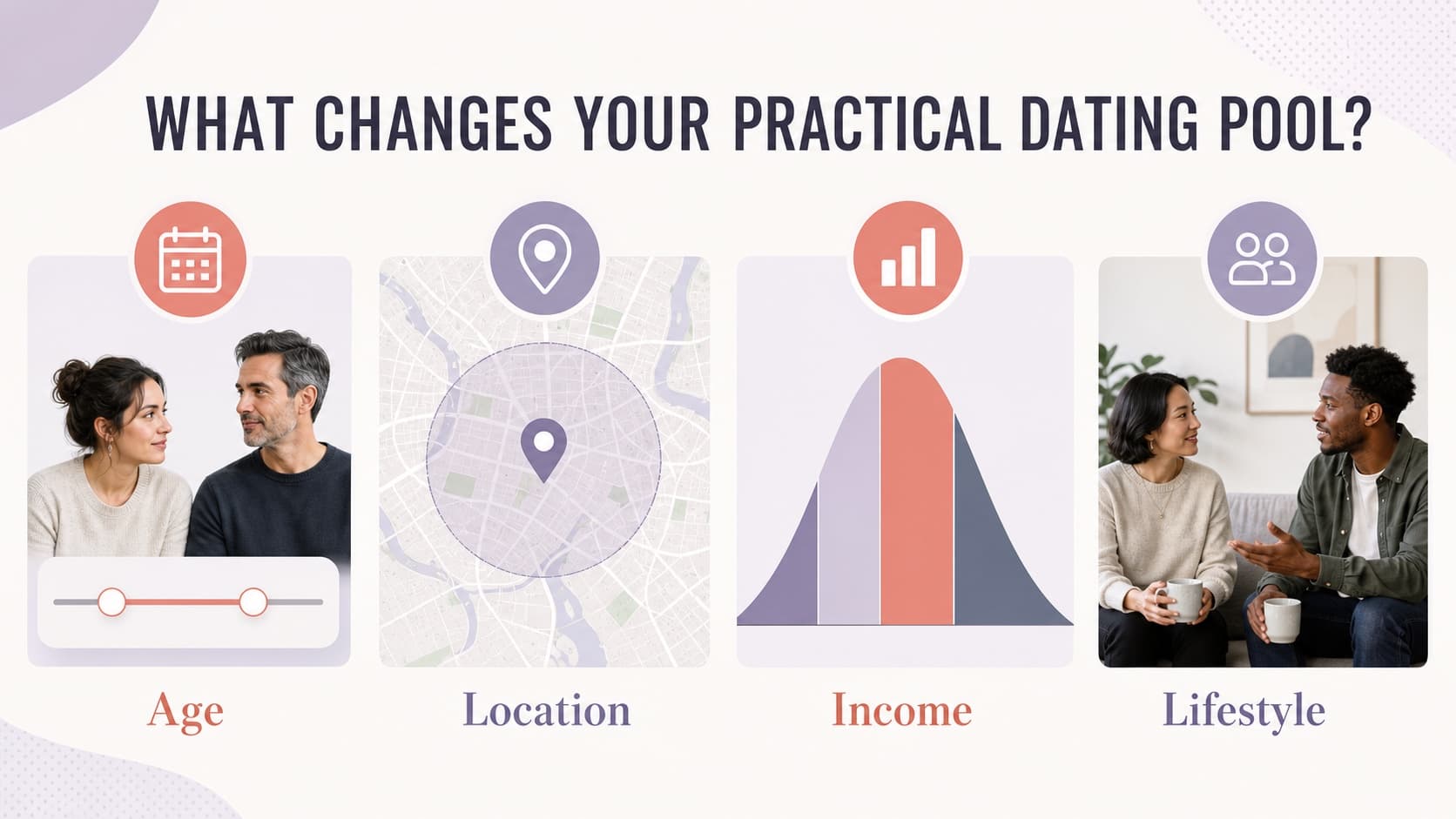
Four factors that change your practical dating pool
Age range
A narrow range can reduce the reference population quickly. It can also interact with relationship status, income, family plans, and geography, so the effect is not always independent.
Location and realistic reach
National prevalence is not local availability. A city, travel radius, transportation access, and willingness to date at a distance determine how much of the theoretical pool is reachable.
Income and other correlated filters
Income varies with age, education, occupation, and geography. Treating every filter as independent can make a result look more precise than the underlying data supports.
Lifestyle and relationship compatibility
Values, family goals, communication, faith, substance use, and daily lifestyle may matter more to a relationship than some measurable filters. Most population datasets cannot combine these qualities reliably.
Pew Research found that half of single U.S. adults in its 2019 survey were not currently looking for a relationship or dates. That finding illustrates why a single-person count is not the same as an active dating pool.
Why pool percentage is not your chance of success
If 5% of a modeled population matches your demographic filters, that does not mean you have a 5% chance of finding a partner. Success also depends on how many relevant people you encounter, whether encounters repeat, where you meet, whether attraction is mutual, and whether both people want the same kind of relationship.
Real dating is clustered rather than random. People meet through neighborhoods, workplaces, friends, apps, communities, hobbies, and age-specific networks. Your actual environment can contain more or fewer relevant people than a national estimate suggests.
How to use a dating pool result well

Protect core standards
Do not relax standards tied to safety, consent, respect, honesty, compatible relationship intent, or essential life goals merely to increase a percentage.
Sensitivity-test flexible preferences
Change one filter at a time. If a small adjustment to height, income, age, or distance changes the result substantially, ask whether that filter measures something essential or acts as a weak proxy.
Compare the estimate with lived experience
If your result appears broad but you rarely meet relevant people, exposure may be the problem. If the result is narrow but your social environment contains many suitable people, national data may not describe your local network well. In that case, use the practical steps in our guide to widening your real-world dating opportunities.
A low result is a reason to inspect assumptions, not a reason to label yourself unrealistic. Our guide to evaluating whether dating standards are too high focuses on that separate question.
Estimate your search breadth
Compare measurable preferences with relationship values, change one condition at a time, and read the result as a range rather than a verdict.
Explore Your PreferencesDating pool percentage FAQs
What is a good dating pool percentage?
There is no validated percentage that is good for everyone. A useful result is one that leaves enough relevant people for your location, timeline, and opportunities to meet, while preserving standards tied to safety and long-term compatibility. The approximate count and the assumptions behind the percentage matter more than a universal cutoff.
Is a 10% dating pool good?
Ten percent can represent a broad practical pool in a large city and a much smaller pool in a low-population area. It still does not show how many people are single, actively dating, nearby, mutually interested, or compatible with you.
Is a 1% dating pool too small?
Not automatically. One percent of 50,000 relevant adults is about 500 demographic matches before availability and mutual fit are considered. One percent of 500 is only five. Always translate the percentage into an approximate count for the population you can realistically meet.
Does a low dating pool percentage mean my standards are too high?
No. It means the selected measurable combination is uncommon within the model. Review filters that are weak proxies or flexible preferences, but do not relax standards that protect safety, respect, relationship intent, or core compatibility simply to increase a score.
Can a dating pool percentage predict whether I will find a partner?
No. A dating pool estimate describes demographic overlap in a reference population. It does not measure exposure, mutual attraction, timing, relationship availability, communication, or whether a relationship will be healthy and lasting.
Sources and editorial methodology
Adam.W wrote and reviewed this article on July 26, 2026. It answers the search question directly while separating demographic prevalence from relationship success. No validated universal dating pool threshold was identified, so the interpretation bands are explicitly labeled as editorial planning guidance.
Claims about survey uncertainty were checked against U.S. Census Bureau ACS methodology. Claims about the share of single adults actively looking to date were checked against Pew Research Center survey reporting. These sources describe populations and attitudes. They cannot predict an individual relationship outcome.
- U.S. Census Bureau: ACS sample size and data quality
- U.S. Census Bureau: Why margins of error matter
- Pew Research Center: Single adults and the dating market
- Pew Research Center: Online dating experiences
This page is educational. It does not provide individualized relationship, mental-health, statistical, or safety advice.
Bottom line
A good dating pool percentage is not a universal score. Start with the approximate number of relevant people, then account for geography, availability, exposure, mutual interest, and compatibility. Keep core standards firm, test flexible preferences, and use the estimate to understand trade-offs rather than judge your worth.