
Data definitions
What Does "Single" Mean in Dating Statistics?
Official data can tell us whether a person is married, divorced, separated, widowed or never married. It cannot, by itself, tell us whether that person is unattached, interested in dating or a realistic mutual match. That distinction changes how every dating-pool estimate should be read.
The quick answer
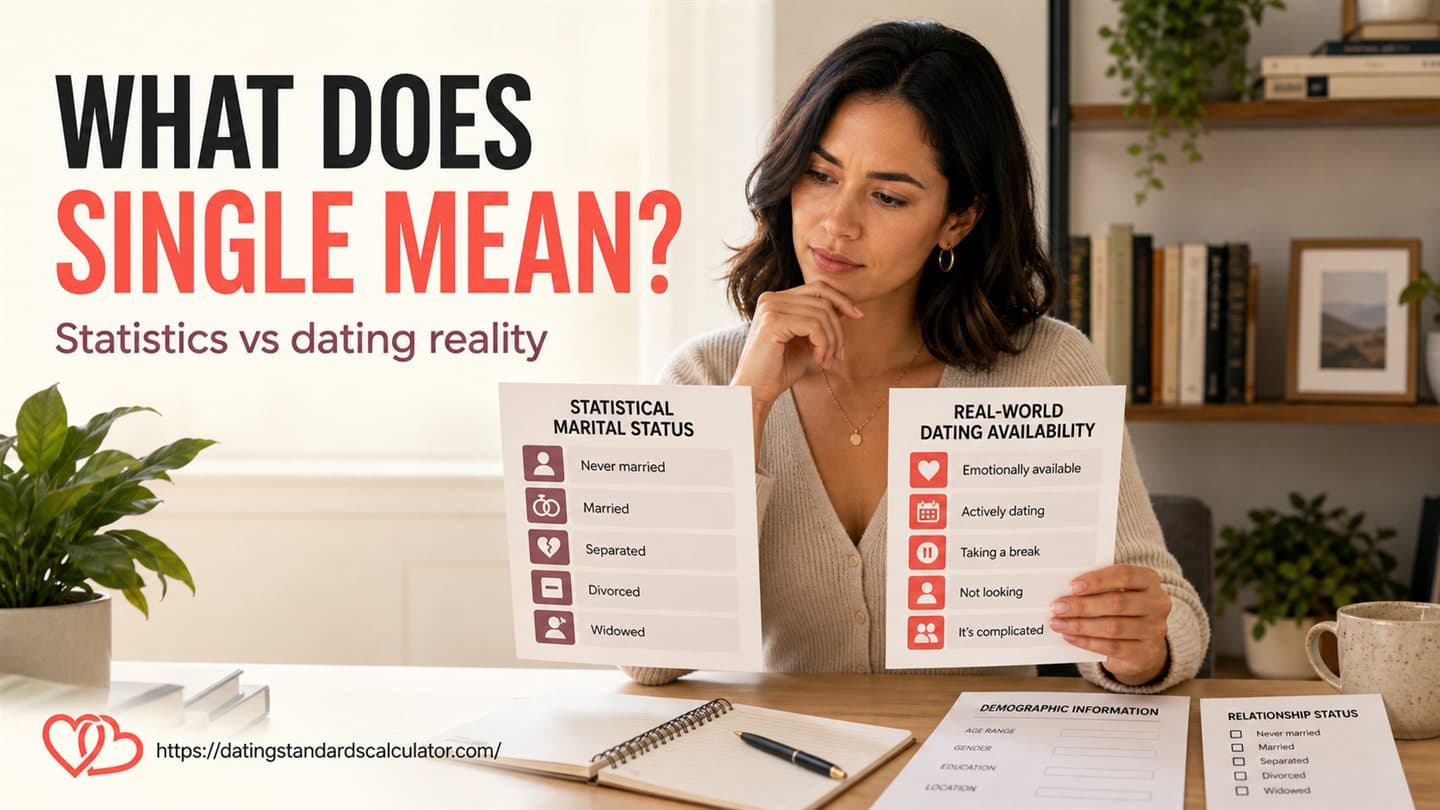
In public statistics, "single" is often shorthand for a marital-status group. In everyday dating, it usually means not currently partnered and potentially open to a relationship. Those are not equivalent definitions.
A useful estimate therefore starts with an explicit population definition. It should never quietly turn "not married" into "available to date." The difference is not a minor technicality: it determines the denominator behind the result.
On the main site, you can compare how selected standards overlap with an estimated dating population. The result is presented as a planning range because public data cannot observe every real-world relationship condition.
What official U.S. data actually records
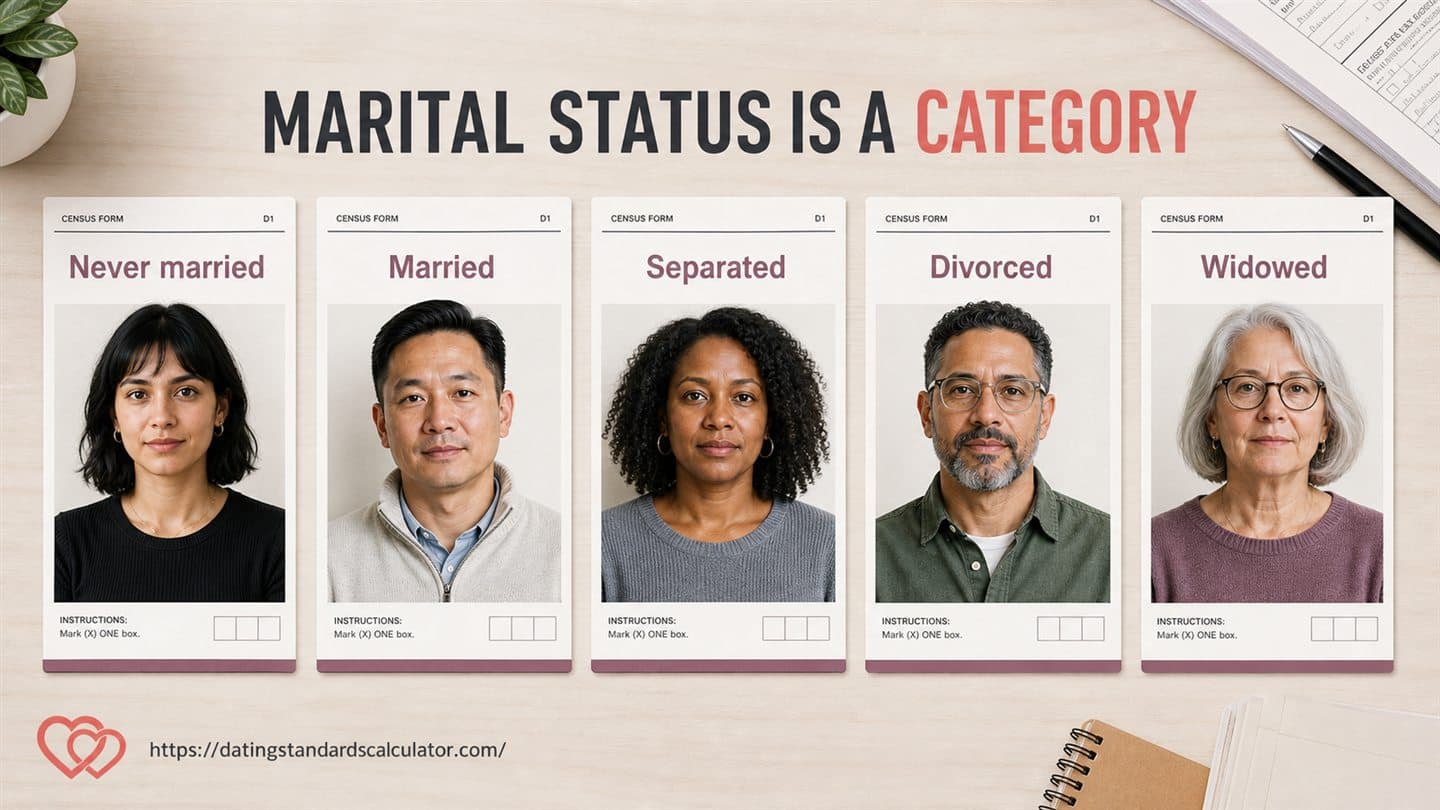
The U.S. Census Bureau's American Community Survey asks people to report one of five current marital-status categories. Table S1201 publishes those categories across age and sex groups. The survey is designed to measure marital status and history, not dating intent.
Now married (except separated)
A current legal-marital-status category; it is not part of an unmarried baseline.
Separated
Still legally married in many cases, but reported separately from now married in ACS tables.
Widowed
A current status following the death of a spouse; it says nothing about present dating interest.
Divorced
A marriage ended through divorce; current availability still requires separate context.
Never married
A statement about marital history, not proof that the person is unattached or seeking a date.
Why unmarried does not mean available to date
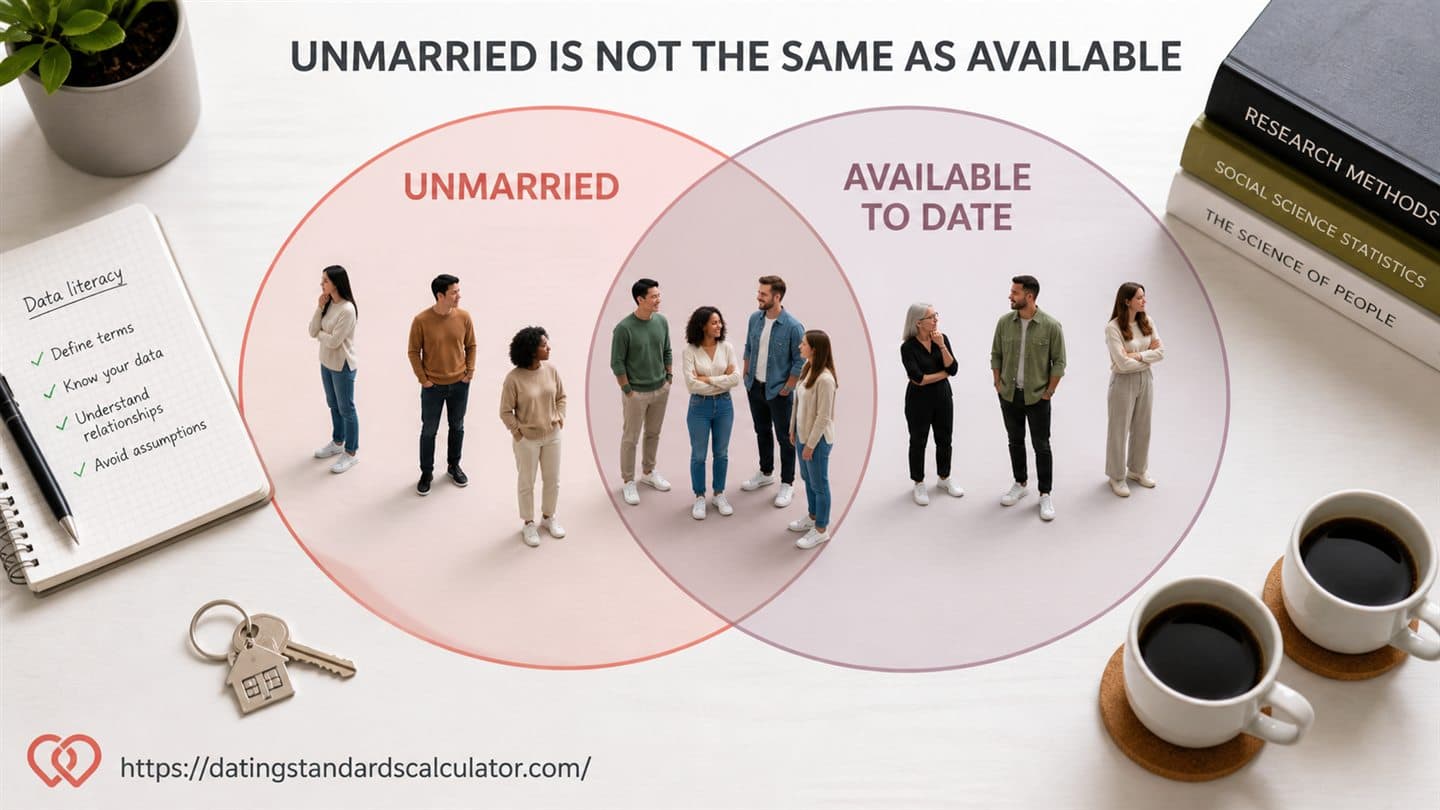
A person who is never married, divorced, separated or widowed may be dating, partnered, cohabiting, taking a break, uninterested in a relationship or unavailable for another reason. Marital status alone cannot separate those states.
Household data adds some context. The ACS can identify an "unmarried partner" in relation to the householder, and Census publications separately describe married and cohabiting couple households. Even that measure has a boundary: it does not identify every romantic relationship, especially partners who live apart or relationships not reported through the householder relationship field.
What data can support
Age, geography, reported marital status and some household relationship categories can define a transparent baseline.
What remains uncertain
Current dating interest, emotional availability, attraction, goals, timing and mutual consent are not directly measured by a marital-status table.
The denominator changes before any preference is applied
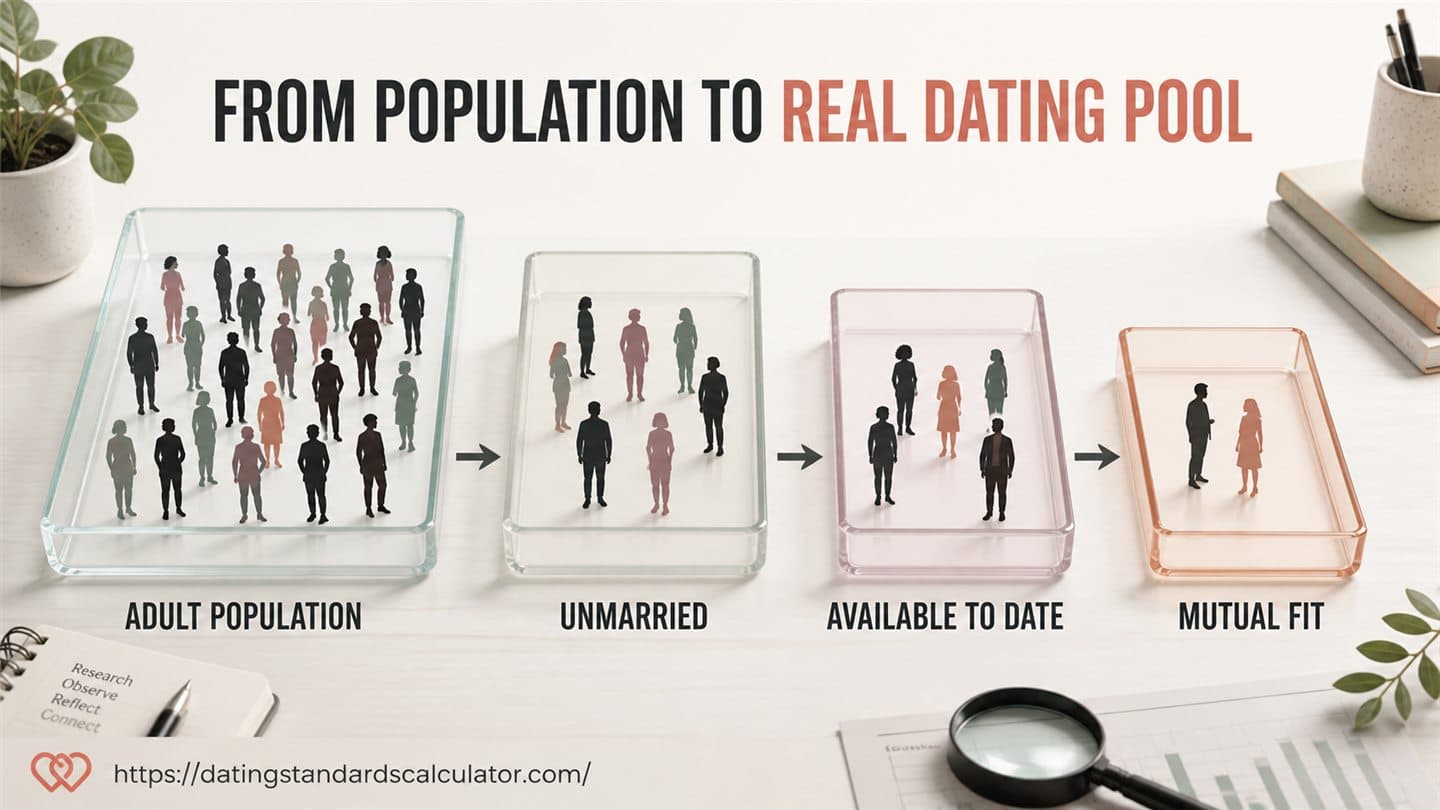
Imagine two models using the same age, income and location filters. One begins with everyone who is not currently married. The other begins with people who are not partnered and are open to dating. Even before the first preference is applied, the second denominator is conceptually narrower.
Public demographic data can estimate the earlier layers more reliably than the later ones. Mutual fit is narrower still: both people must satisfy each other's practical and relationship requirements. Our article on dating-pool estimates versus compatibility explains why a demographic overlap is not a prediction of relationship success.
How Dating Standards Calculator handles the distinction
Our model treats official demographic data as a benchmark, not a complete registry of people ready to date. It separates the selected market, relationship context and active standards, then reports a deliberately broad planning range. It does not claim to know who will be attracted to whom.
Name the country, market and estimate basis shown in the result.
Keep observed demographic inputs separate from planning assumptions.
Use ranges rather than false precision where availability is not directly observed.
Let users change one condition at a time and inspect the direction of impact.
State that demographic overlap is not compatibility or a guarantee of finding a partner.
The full formulas, assumptions, limitations and country-source rules are documented on our calculation methodology page.
Primary sources and review notes
This guide was reviewed against primary U.S. government definitions available on August 17, 2026. Links point to the underlying source or technical documentation rather than a secondary summary.
- U.S. Census Bureau: Why the ACS asks about marital status and marital history
- 2024 American Community Survey, Table S1201: Marital Status
- 2024 ACS Subject Definitions
- U.S. Census Bureau: Married and unmarried coupled households by geography
- CDC/NCHS National Survey of Family Growth: cohabitation measures
Common questions
Does the Census define someone as single?
The American Community Survey publishes marital-status categories rather than a dating-readiness category. Its categories include now married except separated, widowed, divorced, separated and never married.
Is never married the same as single?
No. Never married describes marital history. A person can be never married while cohabiting, in a committed relationship, not interested in dating or otherwise unavailable.
Are divorced, separated and widowed people counted as unmarried?
They may be grouped as not currently married in an analysis, but they remain separate official marital-status categories. Combining them should be stated clearly because their circumstances can differ.
Can demographic data measure who is available to date?
Not directly. Demographic surveys can describe age, geography, marital status and some household relationships. They do not fully observe willingness to date, attraction, relationship goals, timing or mutual interest.
Why does the definition of single matter for a dating-pool estimate?
The definition changes the starting population. A model that treats everyone who is not married as available will usually describe a broader group than a model that accounts for relationship status and dating intent.
Start with a definition you can inspect
A useful dating-pool estimate should show its market, data basis and uncertainty instead of quietly treating every unmarried adult as available.
Explore the data-informed estimate