
Results and methodology
Dating Pool Estimate vs Compatibility: What the Number Misses
A demographic percentage can describe how common a filtered profile may be. It cannot tell you who will be available, who will choose you back, or whether a relationship will work.

One number, two very different questions
Population question
Roughly what share of a reference population may match selected measurable conditions?
Relationship question
Which individual will share mutual interest, values, timing and the ability to build a healthy relationship?
A population model can help with the first question when it has suitable data. It cannot answer the second. Treating the two as interchangeable creates false precision.
The real-world path is a funnel
Reference population
People represented by the available demographic data.
Measurable overlap
People who may match the selected age, location or other modeled filters.
Practical availability
People you could realistically encounter and who are available in the same context.
Mutual interest
Two people notice and choose each other.
Relationship fit
Values, communication, timing and behavior work in real life.
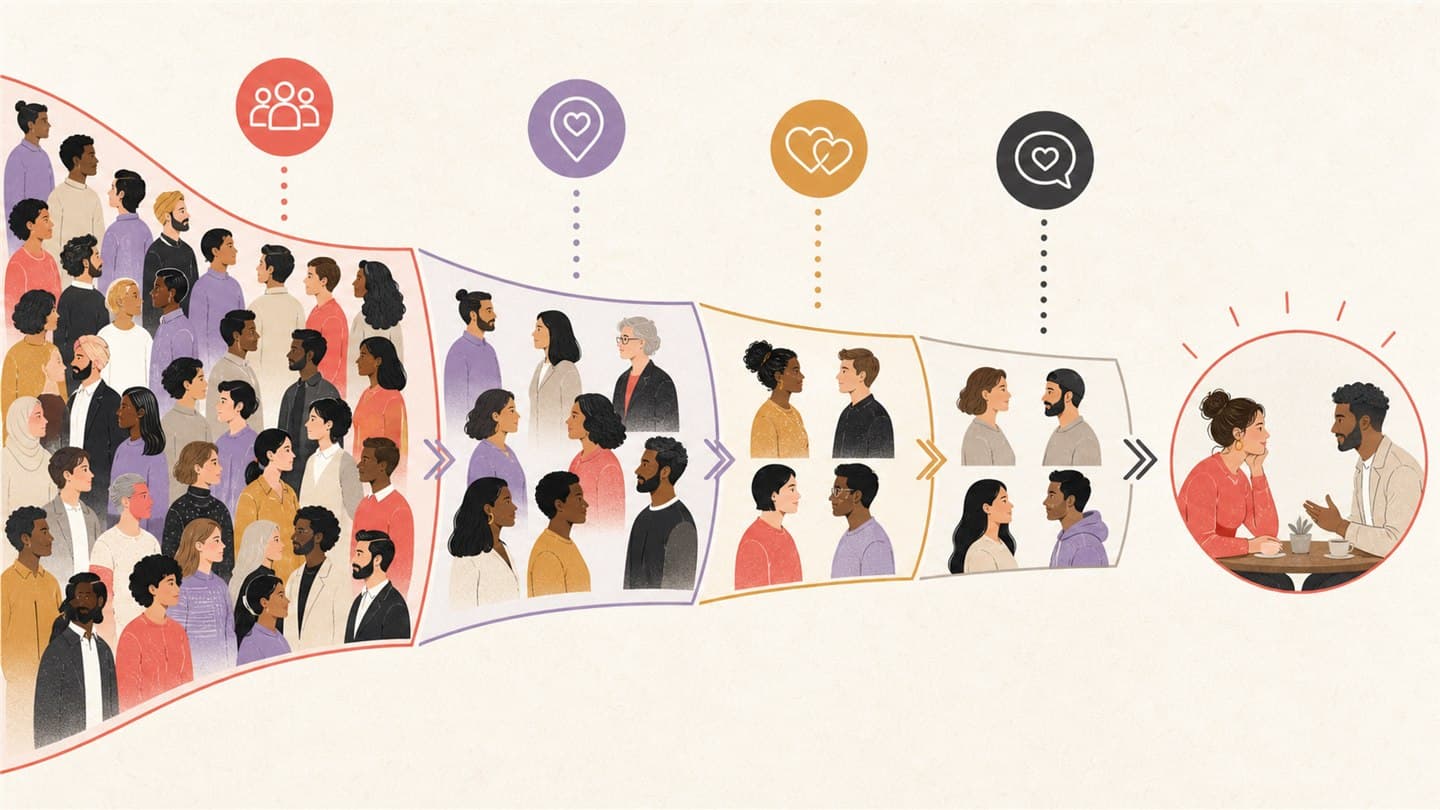
A modeled percentage usually stops near step two. Every step after that depends on access, individual choices and behavior that a demographic table cannot observe.
What a responsible estimate can include
- A clearly named reference population and geography.
- Published distributions for measurable traits where suitable data exists.
- A range or sensitivity estimate instead of an invented exact headcount.
- Visible assumptions, unsupported locations and confidence limits.
- A condition-by-condition view of which filter changes the overlap most.
For a deeper review of modeling assumptions, data gaps and correlated traits, read how to evaluate the accuracy of a dating pool estimate.
What the percentage leaves out

Mutual attraction
A selected trait does not show whether two people feel chemistry or interest.
Availability
Population data may not reveal current relationship status, dating intent or practical access.
Values and behavior
Respect, honesty, emotional maturity and communication are learned through interaction.
Competition and choice
Other people have standards and alternatives of their own.
Meeting frequency
A person who rarely meets relevant people has a different practical path from someone with broad access.
Timing and chance
Even compatible people can meet at the wrong time or never cross paths.
Use the result as a sensitivity test
The useful question is not "What are my odds of love?" It is "Which measurable condition changes the starting pool most?" Keep important relationship boundaries fixed, adjust one flexible condition, and compare the range. Then return to real-world actions such as meeting people, communicating and evaluating mutual fit.

Apply the distinction
Men seeking women can use the focused preference test for men to inspect measurable filters while keeping the result separate from compatibility or success predictions.
There is also no universal target percentage. Our explanation of what a dating pool percentage means shows why context matters more than a fixed benchmark.
A useful estimate stays modest
It names its data source, exposes its assumptions, reports a range and stops before claiming to predict individual people. That boundary makes the number more useful, not less.
Common questions
Is a dating pool percentage my chance of finding a partner?
No. It estimates how common selected measurable traits may be in a reference population. It does not model how many people you will meet, whether both people are available, mutual attraction, compatibility, timing or relationship success.
Can a small dating pool still lead to a good relationship?
Yes. Pool size describes the frequency of a filtered profile, not the quality of a future relationship. A smaller pool may require more time or access, but it does not make a compatible relationship impossible.
Why can two people with matching demographics be incompatible?
Demographic similarities do not guarantee shared values, emotional safety, communication skills, attraction, availability or aligned relationship goals. Those qualities usually require interaction rather than population data.
What is a responsible way to use a dating pool estimate?
Use it as a sensitivity tool. Compare how one measurable condition changes the estimated overlap, note the data coverage and uncertainty, and keep the result separate from predictions about individual people.
Measure rarity, then evaluate people as people
Compare filter effects without turning a population estimate into a promise about attraction, compatibility or love.
Explore the focused test